

Residential / Non-Illuminated Signs

Non-Illuminated Signs
for Residential.

Clear identification for homes and residential settings. Non-illuminated signs rely on proportion, contrast, material and available light rather than internal LEDs. They can provide clear identification with fewer electrical and maintenance requirements.

The application

Where it earns its place.

Building names, entrance identification and internal directions are useful where several homes share an approach; a private house may only need a modest address sign. They suit daytime retail, offices, directories, industrial units and interior branding. Flat panels provide a direct solution, trays conceal edges and fixings, and dimensional letters add depth without introducing lighting.

Entrance visibility, privacy, shared access and the scale of the building shape the specification.

Flat exterior business sign with dark lettering on a light panel
Illustrative example of non-illuminated signs; this is not presented as a documented residential installation.
From brief to upkeep

Details make the difference.

Material choice, fixing and care should follow the conditions of your actual premises.

01 / 04

Specify

Survey the proposed sign position and viewing distance before confirming dimensions and fixings. Aluminium composite, folded aluminium, acrylic, stainless steel, foamed PVC and exterior-grade vinyl cover a wide range of budgets and finishes. The choice depends on size, exposure, rigidity and the quality expected at close viewing distance.
02 / 04

Produce

Panels are cut or folded to the approved dimensions, holes and returns are prepared, and printed or cut graphics are applied to a clean finished surface. Dimensional elements are produced with a fitting pattern for accurate positioning.

03 / 04

Install

Confirm permissions, the substrate and access to shared parts before survey or fitting; some work needs the property manager’s approval. Direct screws, stand-off locators, rails or concealed studs are selected for the sign weight and substrate. The survey identifies uneven surfaces, existing holes and access constraints before the panel or letters are made.

04 / 04

Look after it

With no lighting components, maintenance is mainly cleaning and checking fixings. Replaceable face graphics can extend the useful life of a sound panel or tray when details change.

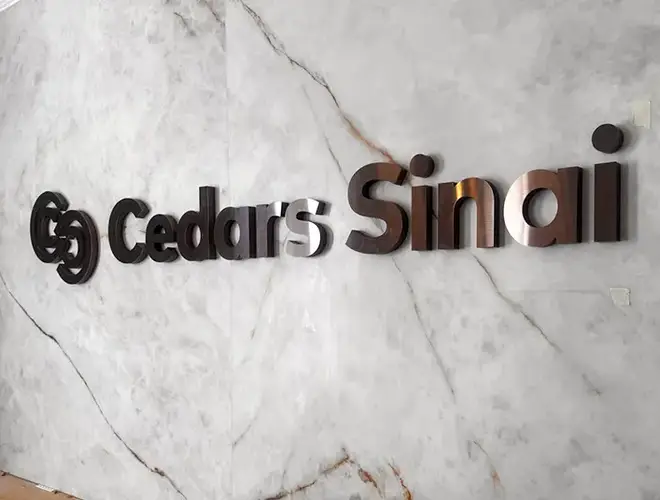
Example of applied interior wall signage in a finished room
Illustrative signage example for discussing the residential environment; not a documented sector-specific installation.
Think beyond one surface

See the whole setting.

Residential briefs range from a single private entrance to shared lobbies and managed developments. The useful question is what residents, visitors and deliveries need to identify without adding unnecessary visual noise.

Building names, entrance identification and internal directions are useful where several homes share an approach; a private house may only need a modest address sign.

All Residential options
Tell us about your space

Ready to put it in place?

Tell us about your residential site and what you need from non-illuminated signs. We can discuss size, finish, access and timing before quoting.

Get a quote
Chat on WhatsAppUsually replies quicklyCall now020 8004 6934Contact usTell us about your project