
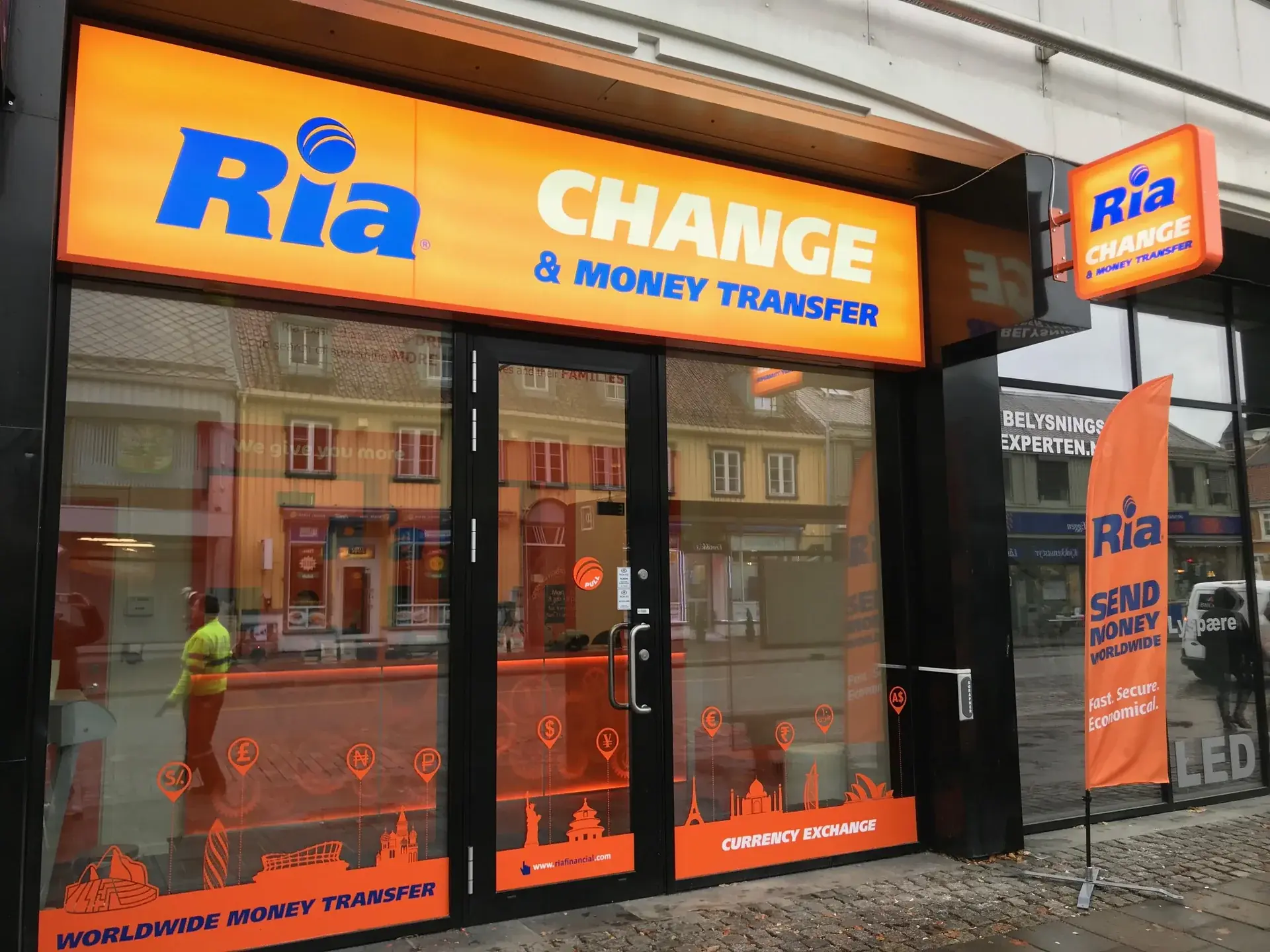
Stand along the pavement rather than directly opposite your shop. Can you find the entrance before you reach it? Then move across the road: can you identify the business without reading everything in the window? A useful shopfront solves both tasks. Adding more wording to the fascia does not necessarily help someone approaching at an angle.
One photographed frontage, three different jobs
The Ria Money Transfer project combines an illuminated “Change & Money Transfer” fascia, a double-sided projecting sign and orange lower-window graphics. The published photographs also show the same orange-and-blue identity continuing inside. Instead of asking one sign to carry all the information, this frontage uses different surfaces for different viewing positions.
- Fascia: identify the premises in a front-on view, using a clear primary message.
- Projecting sign: provide an additional view for someone walking along the pavement.
- Window graphics: carry supporting service information at closer range without duplicating every line of the fascia.
View the Ria Money Transfer exterior signage and interior graphics project — See the exterior and interior photographs together.
Fascia sign options — Compare the main identification layer with the role of the projecting sign and windows before choosing the fascia specification.
Try these street-level checks on your current shop
Take a front-on photograph and an approach photograph from each direction, where it is safe to do so. Look at the images at a modest size, not zoomed in. If the important wording disappears, the issue may be hierarchy, contrast or obstruction rather than the quality of the print. A phone photograph is an initial comparison, not a substitute for checking the real frontage.
Next, separate permanent identification from information likely to change. Your name may belong on the main sign; a short promotion usually needs an easier replacement route. If you trade after dark, revisit the same views during your actual opening hours. Daylight photographs alone cannot tell you how the sign reads against surrounding lights.
Finally, check the door. A beautifully coordinated fascia and window treatment can still leave a first-time visitor unsure which opening to use. Keep the arrival information distinct from decorative patterns, especially where the frontage includes several doors or a shared entrance.
Decide what the replacement must solve before choosing a finish
Write one concrete problem in the brief: for example, “the business name is hidden on the left-hand approach” or “visitors confuse our entrance with the adjoining unit”. These are questions a proposed layout can answer. “Make it more premium” is not enough on its own to choose between a flat panel, raised lettering and illumination.
Then confirm the physical limits: usable fascia area, substrate, existing fixings, access and any consent requirements. A landlord or local authority may constrain the proposal, so do not order a sign on the assumption that a previous installation automatically permits a new size, projection or lighting arrangement.
When advertisement consent is needed — Use the national guidance as a starting point, then confirm the proposal with the relevant council and property owner.
What a comparable quotation needs to include
A price comparison is only useful when the scopes match. Ask each quotation to distinguish the fascia or lettering, any projecting sign, window graphics, removal of existing work, electrical work and installation access. Some of those items may not be needed; the point is to see what is included rather than infer it from one total.
We have not published a cost for the Ria project because the case study does not contain an approved price breakdown or numeric dimensions. Its value here is the visible allocation of information across a real frontage. Your own specification should begin with the viewing problem and site conditions, then establish the budget for that defined scope.
From the journal
Featured articles
More practical ideas for your next signage project.
More published stories are on their way. Explore the journal for now.