
How to Plan Wayfinding Signage for Clear Visitor Journeys
Someone looking for a meeting room needs an answer at the junction, not a general welcome message behind them. Wayfinding starts with a sequence of decisions: where am I, which way do I go and how will I know I have arrived? Counting signs before mapping those decisions often produces more panels without a clearer route.
A conference with several destination types
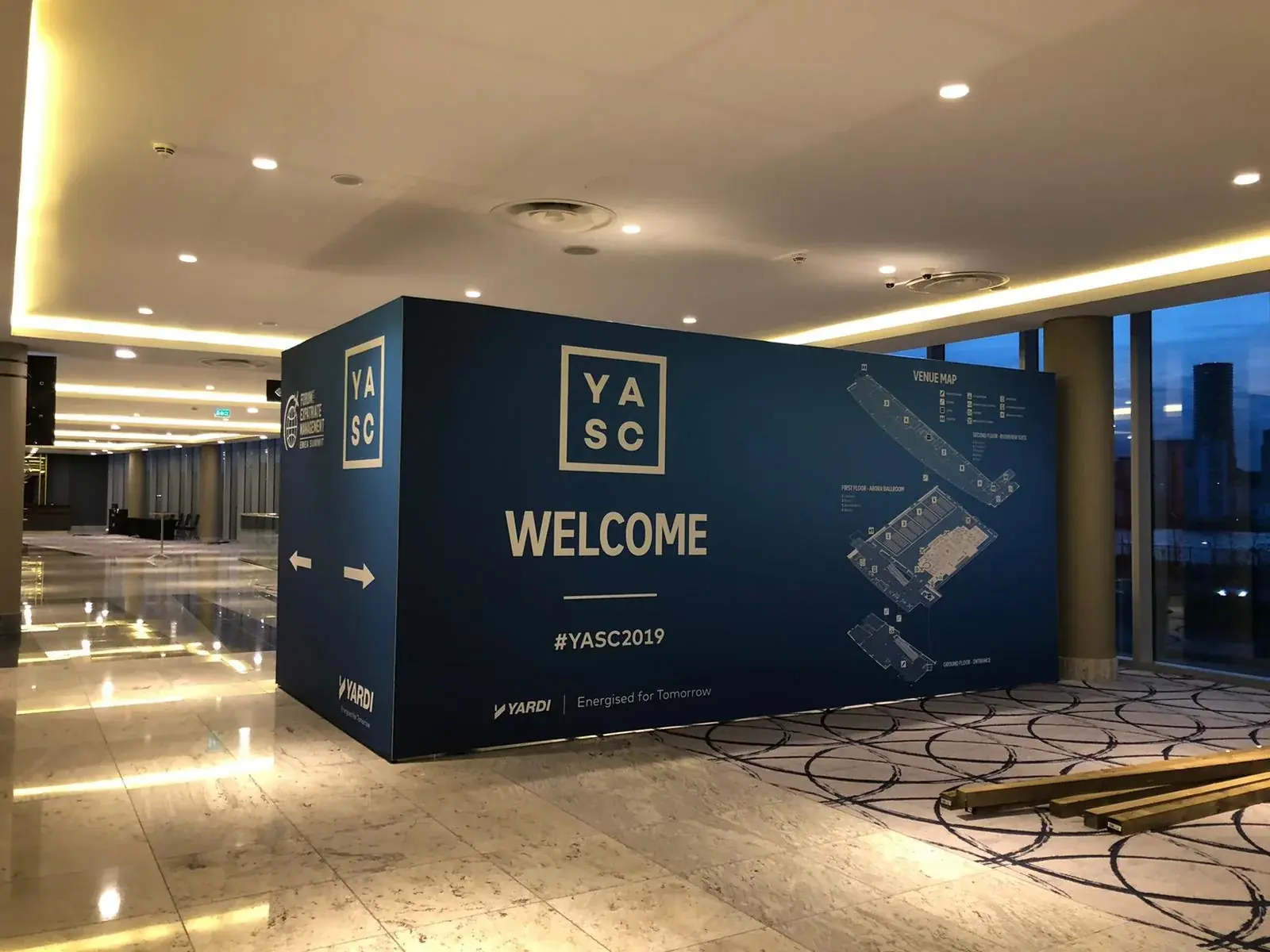
The YASC 2019 installation at InterContinental London included a welcome board and venue map, directions to the Riverview Suite on Level 2, named breakout rooms and private Meeting Rooms 1 and 2. Registration, the Arora Ballroom entrance, escalators and lift areas also carried coordinated graphics. The published record is useful because it shows several kinds of information within one event, not just a standalone arrow.
View the YASC 2019 Dibond board graphics project — Inspect how destination names and the blue-and-white event identity recur across locations.
Do not ask a map, an arrow and a door label to do the same thing
- Orientation: a map or directory helps someone understand the overall arrangement and choose a destination.
- Direction: a sign at a junction answers the immediate question of which route to take.
- Confirmation: a room or entrance label tells the visitor that the chosen route has ended in the right place.
A map does not remove the need for a direction at a later turn. Equally, a direction reading “Meeting Rooms” may be insufficient if visitors need to distinguish a private meeting from a breakout session. Use the names people receive in their booking or invitation, and agree those names with the person who owns the venue information.
Make a route schedule before an artwork schedule
Choose one arrival point and one destination. Walk between them as a first-time visitor would. At each choice, record the question the visitor needs answered, the wording that answers it and the place where that wording becomes visible. Repeat the exercise from the lift or another entrance if it creates a genuinely different route.
This record should identify gaps as well as proposed signs. A sign beyond a junction cannot help someone choose before the junction. Obstructed walls, open doors and temporary furniture can also change what is visible. Review positions in the occupied space, not only on a floor plan.
Planning a coordinated wayfinding sign system — Translate the route decisions into a consistent specification for directions and destination labels.
- Arrival question: where is registration? Record the first decision and the destination name.
- Change of level: which lift or stair route reaches the required floor? Check the information at both ends.
- Room approach: which of the nearby doors is the booked room? Add clear confirmation at the destination.
Test the wording with someone who does not know the building
Ask an unfamiliar colleague to follow the proposed route without coaching. Record where they hesitate and what information they look for. This is a practical design check, not a measured claim about the YASC project. Amend the wording or position where the test exposes ambiguity, then check accessibility requirements with the venue and appropriate specialists.
Approved Document M guidance for access to buildings — For applicable work in England, review building-access requirements with the venue and a suitable professional; a route test alone does not establish compliance.
For an event, assign someone to approve room names and late changes. For a permanent building, keep a controlled destination list so reception staff, booking emails and signs do not use different names for the same place. The useful deliverable is a maintainable route system, not a larger collection of unrelated arrows.
From the journal
Featured articles
More practical ideas for your next signage project.
More published stories are on their way. Explore the journal for now.